Gidley's Gossipings

A blog about not much really

OpenTV: Actionable Rails Analytics

2026-09-09 Tech Ben Gidley

Most analytics on a TV interface end up in the same place: a dashboard someone checks once a quarter. This is useful for a retrospective, useless in the moment when a rail is actively showing the wrong things to the wrong person.

Actionable Rails Analytics, is built on a simpler premise — measurement should feed straight back to the person and systems managing the rail it’s measuring, not into a report about the rail. Engagement signals on individual tiles get tracked live, and that signal directly is available to the editor curating the rails.

Continue reading
OpenTV: Personalized Reviews

2026-09-07 Tech Ben Gidley

Plenty of people have a negative reaction to recommendations. The suggestions might be perfectly good, but they don’t much like the idea that a machine knows them. We hear that in customer feedback, and we can see it in the data — a rail explicitly labelled as recommendations gets less engagement than exactly the same weighting applied quietly inside an ordinary list or a set of search results.

So instead of hiding the AI harder, we went the other way. Personalized Reviews (patent pending) puts the model that does the recommending into the audience’s hands, in a form that reads as human rather than statistical.

Continue reading

iPlayer: Up to 27% of all viewing

2026-09-03 Tech Ben Gidley

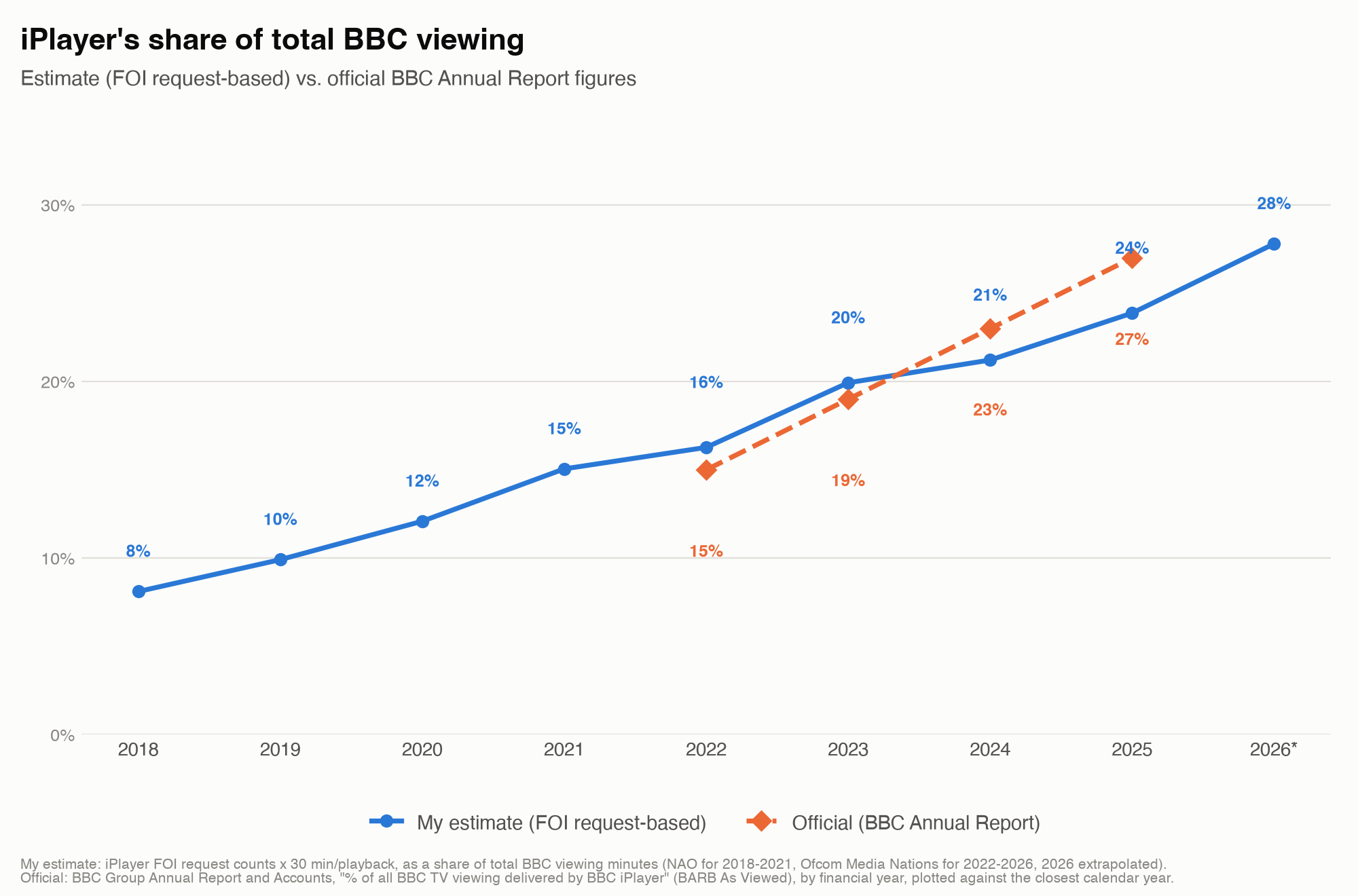
IBC is just around the corner, which means it’s time for my annual look at how the BBC’s broadcast-to-OTT transition is going. I’ve been publishing this since 2019 via Freedom of Information requests, since iPlayer’s device-level usage isn’t published regularly.

Line chart comparing an FOI-request-based estimate of iPlayer's share of total BBC viewing since 2018 against the BBC's own official annual report figures since 2022/23, both rising from around 15% to 27%

We’re now up to 27% of all BBC viewing on iPlayer (the rest being broadcast platforms) — we can expect to see that rapidly accelerating - 16-34’s are already up to 63%. This mirrors what I’m seeing on PayTV services around the world - there is likely to be rapid transition to OTT delivery, as the tipping point economically is being reached. Financially investment in new (non internet) broadcast delivery is looking harder and harder to justify.

Continue reading

Can a Nikon look like a Fuji? An AI says yes.

2026-05-09 Photography Ben Gidley

In my last post I wrote about borrowing a Fujifilm X-E5 to find out whether the grass was greener. My conclusion was that the film simulations are good but not better — just different — and that Nikon’s Flexible Picture Control on the Z5 II and Z6 III looked like it could produce richer results. I found a deal on a Z6 III, ordered it, and waited.

The camera arrived. First order of business: set up a custom Picture Control using Flexible Picture Control, aiming for the kind of rendering that made Fujifilm so appealing — vivid, slightly lifted greens, smooth shadows with a gentle glow, a look that feels alive without being garish. No post-processing, just the in-camera JPEG.

Continue reading

Why I didn't move to Fujifilm

2026-05-01 Photography Ben Gidley

I prefer shooting JPEG. I’ll do RAW when I need to — DXO PhotoLab does a good job — but most of the time I can’t be bothered. So colour straight out of camera matters to me, and that’s what started this whole detour.

I’ve been shooting on a Z5 with Picture Control 2 and it’s fine, but I’ve felt its limits. Meanwhile Fujifilm’s reputation for gorgeous straight-out-of-camera JPEGs kept coming up, and the influencer community around film simulation recipes was hard to ignore. Add in the metal body, the mechanical dials, the overall feel of the thing — I learned photography on a fully manual film SLR and Fujifilm clearly understands that shooting experience in a way most modern cameras don’t. I was tempted.

Continue reading

Growing Trend of Broadcast to OTT Delivery: Insights from iPlayer

2024-09-10 Tech Ben Gidley

IBC is just around the corner, which means it’s time for my annual exercise in asking the BBC how the transition from broadcast to OTT delivery is going. This is something I’ve been doing since 2019 as I was curious to see how it progresses and given the BBC ‘unique’ model of funding it’s a good indicator of how consumers want services to behave ( once you take away paying for it). The data this year seems to show the trend continuing in a ‘linear’ fashion with usage growing year on year. This corresponds to OFCOM data which suggested that iPlayer was 14% of all viewing in Jan 2024, growing to 18% by mid year.

Continue reading